






As the gentoo fledglings prepare to leave the island, wildlife monitor Pete Watson reports on the post-crèche chick count.
Hello again!
I’m Pete, the wildlife monitor at Port Lockroy. My colleague Alette completed the first whole-island survey, focusing on egg occupancy. Since taking over in December, I’ve been responsible for tracking the colony’s progress, especially the exciting stage when the chicks hatch and develop into adult gentoo penguins.
In January, I reported the season’s first full-island chick survey, and I have now completed the final whole-island post-crèche chick count of the season.
The fledgling behaviour of gentoo penguin chicks marks the transition from nest-bound juveniles to independent foragers. After several weeks of parental care, chicks shed their down for waterproof juvenile feathers, gather in small crèches, and begin exercising by stretching and flapping their flippers, before venturing down to the beaches to begin swimming lessons.
Whole-island post-crèche chick count
By the time crèching really gets going on Goudier Island, the neat, earlier-season colony boundaries stop being useful. Once the chicks are mobile, they drift, merge, and reshuffle into loose groups that ignore every imaginary line we have drawn on a nest map.
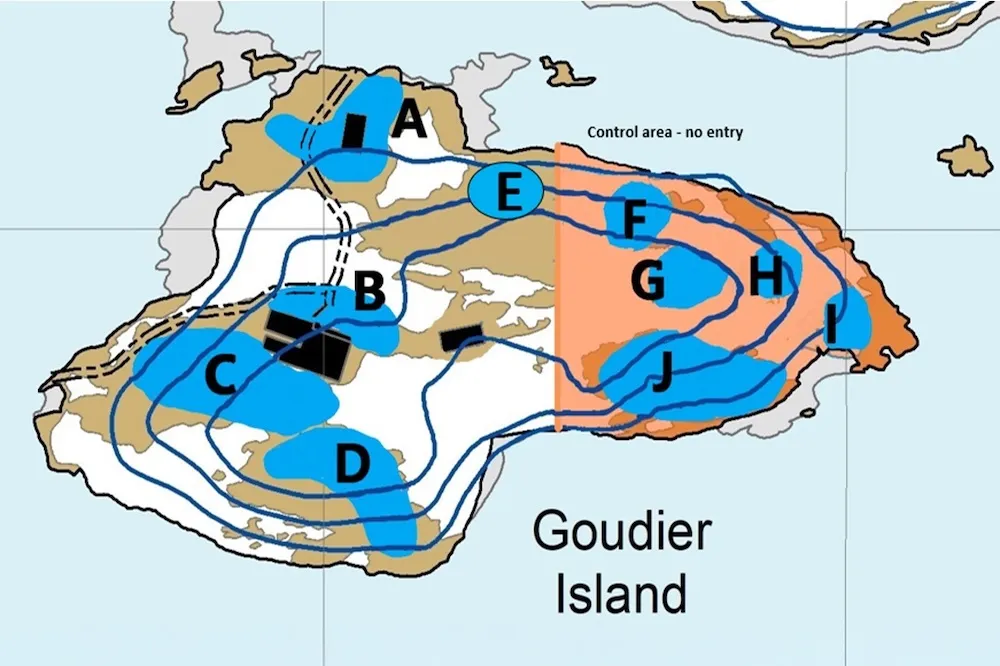
This is why the whole-island post-crèche chick count has its own distinct process. At this stage, the aim is simple: count every chick on the island, and as such, the method has to adapt to how the colony now behaves.
I waited until most chicks had entered the crèche phase, meaning they were clearly mobile and no longer standing on their own nests. That’s the key trigger. If you go too early, you’re still fighting nest-based structure; too late, the groups can become even more fluid, and you risk more movement during counting.

The goal is to count all chicks on the island, post-crèching. Because chicks wander freely, I treated the island as a set of discrete counting zones rather than “colonies.” The team completed repeat counts of each area and recorded them all, even when they differed.
Setting up the count
Since colony boundaries become nearly meaningless during crèche, we worked the island in a slow, deliberate sweep and created counting areas based on natural features such as rock edges and outcrops; gullies and little dips in the terrain; obvious breaks between chick clusters; and lines of sight from higher ground.

Where possible, we used a higher counting station to “recce” (scan) the surrounding ground first, then counted from a distance so we weren’t influencing chick movement.
A critical part of the method is that these areas need to be mappable. In practice, that means: if I say “Area 3,” I can point to it on a sketch map and identify it again later. The boundaries aren’t “colonies”; they’re practical counting units.

Slow feet, fast counts
Crèche chicks are mobile, but they’re not constantly moving. The trick is to wait for a lull, then count quickly before the group reshuffles. We waited until the chicks were mostly still, then counted as quickly as possible without sacrificing accuracy. We used natural features like rocks or ridges as checkpoints to keep our place, only shifting position at those points. For dense or messy clusters, we immediately re-counted the small area until we were confident in the result.

When a group was difficult – dense, active, or visually confusing – we imagined (and stuck to) a firm line across the ground and treated it like a boundary. This reduces double-counting when chicks drift back and forth.
For each counting area, we did multiple repeat counts and recorded them. Once consecutive counts differ by less than 10% at a given station/area, we stop counting and record the average.
| Category | Count 1 | Count 2 | Count 3 | Count 4 | Average |
|---|---|---|---|---|---|
| Total outside control area | 538 | 551 | 527 | 538 | 539 |
| Total inside control area | 139 | 146 | 152 | 147 | 146 |
| Total fledglings | 677 | 697 | 679 | 685 | 685 |
A season shaped by hardship, resilience and reward
Overall, the breeding season can be considered successful. Chick numbers are only slightly lower than last season, and this modest reduction can be largely attributed to a particularly strenuous period of heavy rainfall during the pre-crèche stage of their development.
Sustained rainfall rapidly turns the guano-rich ground underfoot into thick mud; when this coats the chicks’ downy feathers, it compromises their insulation, reducing their ability to retain heat and leaving them far more vulnerable to hypothermia.

Despite this setback, the colony has performed remarkably well. It has been an absolute privilege to work at Port Lockroy, and especially to spend time with these penguins – marine animals that are relentlessly charming, tough, and resilient, persisting through extraordinary challenges in some of the harshest conditions on Earth.
As the austral summer progresses, the fledglings are now making tentative trips to the shoreline, learning to enter the water and swim – often hesitantly at first – before they eventually head out to sea to feed on their own and face their first Antarctic winter.

I look forward to their return next season and to seeing how the colony continues to fare, with the ongoing story picked up and carried forward through the reports of the next wildlife monitor.
Finally, a heartfelt thanks goes to everyone who has adopted a penguin and supported this valuable study. This work simply wouldn’t be possible without you.
If you love a place, protect it
UKAHT is committed to making Antarctica, its heritage and its stories accessible to everyone.
Eighty years in Antarctica have left their mark on this beloved site. Now, Port Lockroy urgently needs restoration to protect its future. Please donate today.
Adopt a penguin
follow a unique colony at the end of the world
Your adoption directly supports on-site colony monitoring and conservation at Port Lockroy. Funds go directly to paying for a wildlife monitor to travel to Antarctica and study the penguin colony at Port Lockroy for the austral summer.