






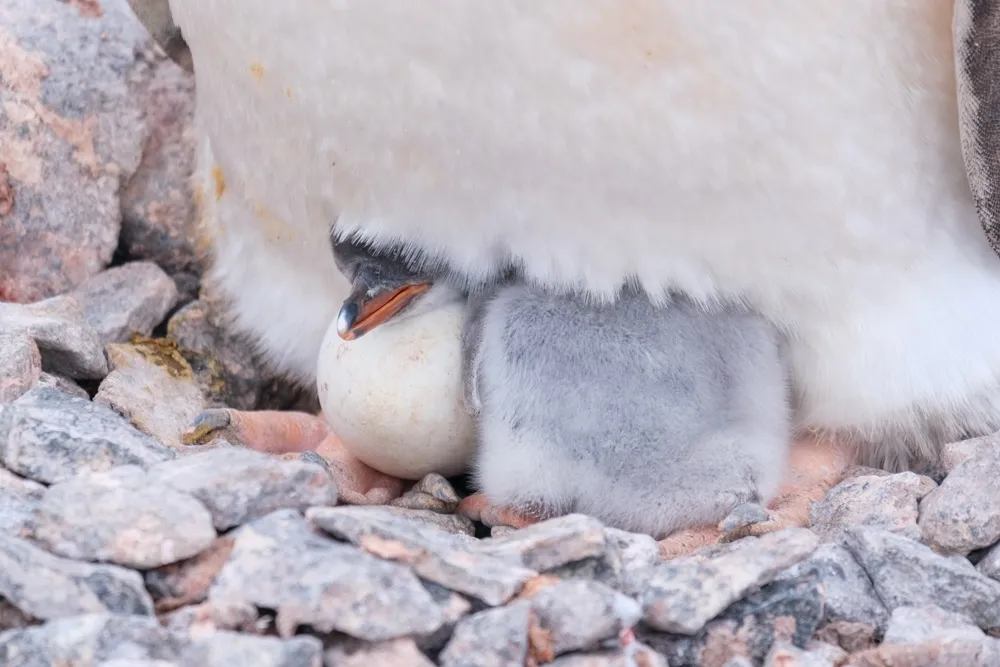
For Penguin Awareness Day, wildlife monitor Pete Watson reports on the season’s first full-island chick survey at Port Lockroy
Hello!
I’m Pete, the wildlife monitor at Port Lockroy for the second half of the 2025/26 season. My colleague Alette cared for our feathered friends earlier in the season and carried out the first whole-island survey, focusing on egg occupancy.
Since taking over in December, I’ve been responsible for tracking the colony’s progress, especially the exciting stage when eggs finally become hatchlings.

How the survey works
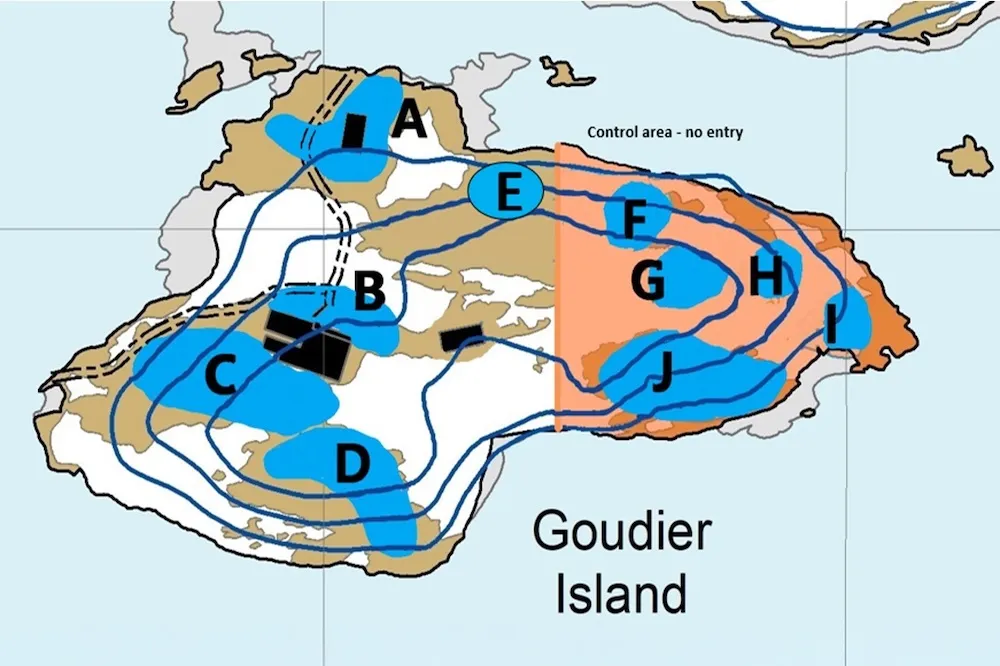
Goudier Island is divided into two zones. The first, larger zone is open to visitors who follow dedicated paths that protect both the penguins and their nesting sites. We never enter the colonies, and the penguins, naturally, always have right of way.

The second, smaller zone is the penguin study area. This area remains closed to people throughout the season, except during whole-island counts or when our colleagues from Penguin Watch visit to service their remote cameras. Whenever we enter the study area, we record the time, date, duration and number of people present to keep disturbance to an absolute minimum.
Across the season, the study records every nest, egg and chick on Goudier Island so we can compare results year-on-year across both areas of the colony.
There are 10 subcolonies on the island. To reduce footfall, I only visit one, the chronology colony, every three to four days. The timing of the whole-island counts is based on the breeding progress we observe there.
Why this research matters
The data we collect is shared with the British Antarctic Survey, the UK’s national polar research institute. It forms part of a long-term study, now more than 20 years in the making, that helps us understand the breeding success and future resilience of gentoo penguins.

Penguins play an essential role in Antarctica’s fragile ecosystem. Port Lockroy is uniquely valuable because it is the only place in Antarctica where we can monitor an entire breeding season consistently, year after year – offering rare insights into how these remarkable seabirds are adapting to a changing world.
We’re incredibly proud to contribute to this work. Anyone who feels inspired can support the colony by adopting a penguin and helping protect their long-term future.
As well as monitoring the gentoos on Goudier Island, we also conduct counts at nearby Bills Island, Jougla Point and Damoy Point, and record all other wildlife sightings in the area throughout the season.
The results of our whole-island chick count
Gentoo penguins usually lay one or two eggs (occasionally three) and share incubation duties, carefully swapping over each day. The chicks hatch at around 35 days. This year, the first chick we recorded emerged in the chronology colony in early December, and those two are now the largest chicks on the island.
The parents feed their young with partially digested food, gently passed from bill to bill. The chicks need regular feeding to stay warm, healthy and growing fast.

On 4 January, the chronology colony reached 95% chick occupancy, which triggered the first full-island chick count of the season. Two days later, the whole team headed out in pairs, each group responsible for two subcolonies, while our base leader, Lisa and I entered the control area to survey the remaining five.
By the end of the morning, we had recorded 557 occupied nests and at least 876 chicks – a joyful and encouraging result.

For me, time spent among these charismatic birds – especially when the chicks are at their fluffiest – is the highlight of life at Port Lockroy. For the rest of the team, the count is a welcome break from their daily responsibilities at the base.
After the count, we gathered back in the Nissen Hut to swap stories from the morning. It’s moments like these that remind us what a magical and truly extraordinary place we’re lucky enough to call home for the season.
If you love a place, protect it
UKAHT is committed to making Antarctica, its heritage and its stories accessible to everyone.
Eighty years in Antarctica have left their mark on this beloved site. Now, Port Lockroy urgently needs restoration to protect its future. Please donate today.
Adopt a penguin
follow a unique colony at the end of the world
Your adoption directly supports on-site colony monitoring and conservation at Port Lockroy. Funds go directly to paying for a wildlife monitor to travel to Antarctica and study the penguin colony at Port Lockroy for the austral summer.