






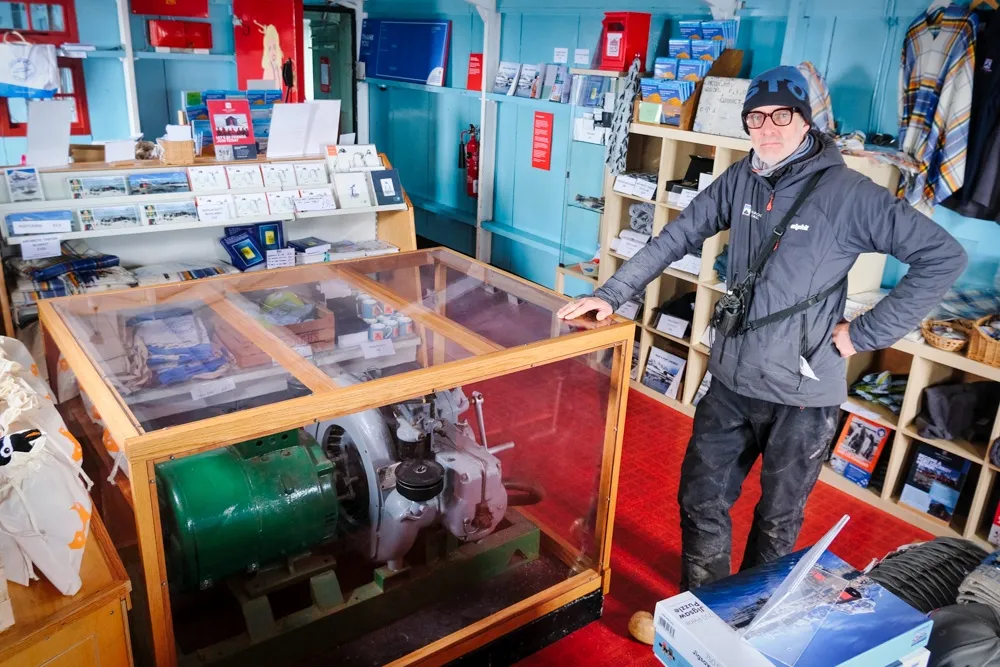
Conservation carpenter Jo installs a generator cover that protects the Bransfield House artefact while enhancing visitor experience at Port Lockroy.
Working in a historic building like Bransfield House means that even the smallest modern interventions need careful thought. When it came to the generator housed in the museum shop, it was clear that a solution was needed that balanced safety, functionality and respect for the historic fabric of the building.
There were two main reasons for building a bespoke cover. The first was protection: safeguarding the generator from accidental damage by visitors, and equally protecting visitors from the generator itself. In a busy, compact historic space, those risks run both ways. The second aim was more subtle but just as important — to create a practical surface where visitors could pause, reflect and write postcards home while inside the shop.
Any new addition to a heritage site like Port Lockroy has to earn its place.

Designing and building in Somerset, UK
The cover was designed and constructed in my workshop in Somerset, UK, before being dismantled into manageable sections for transport south. The design is deliberately simple: an oak frame with clear polycarbonate panels to the sides and top, all neatly rebated into the timber.
While the form may be understated, the execution had to be exact. In conservation work, accuracy and attention to detail matter enormously, even when the object itself is contemporary. I chose European oak for its durability, strength, and workability, as well as its natural beauty. Finished in hardwax oil, the timber is protected while allowing the grain to remain visible — an honest material choice that sits comfortably within the historic interior.
For the transparent panels, polycarbonate was selected over acrylic (Perspex). It is tougher, less prone to scratching and better suited to a working museum environment. The supplier cut the panels precisely to my specifications, leaving me to finish the edges, drill and countersink the fixings, and carefully prepare them for final assembly. Protective film stayed in place until the very end, and everything was packed using eco-friendly materials for the long journey south.
Adapting to a small rock in Antarctica
Despite careful packing, the oak frame suffered significant damage during transportation. That meant undertaking fairly major reconstruction work on site — something that is always more challenging away from a fully equipped workshop.

But conservation carpentry, particularly in Antarctica, demands adaptability. Working on a small rock at the end of the world, you use what you have, make careful decisions, and keep the wider conservation aims firmly in mind. Once repaired, the frame was reassembled using the joints originally cut and fitted in the UK. Thankfully, everything went together as intended.
The polycarbonate panels were then fixed in place using a deliberately simple system. Ease of repair and future access are central to good conservation practice — nothing here is over-engineered or irreversible.
A discreet but purposeful addition
Once the protective film was removed and the generator cover given a final polish, small location tabs were added to prevent movement, along with discreet ventilation holes to reduce condensation. Crucially, the cover sits on the generator’s concrete plinth and does not interfere with or damage the historic fabric of the building in any way.

Although modest in scale, the cover has had a noticeable effect. The generator now feels more intentional, almost ceremonial, within its own case. It is protected, legible and respected — and the surface it provides has become a natural place for visitors to stop, write, and connect with the story of Port Lockroy before sending a message home from Antarctica.
For me, that balance — protecting heritage while quietly supporting the visitor experience — is what good conservation is all about.
If you love a place, protect it
UKAHT is committed to making Antarctica, its heritage and its stories accessible to everyone.
Eighty years in Antarctica have left their mark on this beloved site. Now, Port Lockroy urgently needs restoration to protect its future. Please donate today.
Adopt a penguin
follow a unique colony at the end of the world
Your adoption directly supports on-site colony monitoring and conservation at Port Lockroy. Funds go directly to paying for a wildlife monitor to travel to Antarctica and study the penguin colony at Port Lockroy for the austral summer.