






Organising anything in Antarctica is a bit like an episode of Grand Designs. Everything takes way longer, goes over budget, and someone has a baby (or lays an egg) halfway through.
Port Lockroy is a home to the historic Bransfield House, which is maintained by the team for the Austral summer as a museum, post office and gift shop. The team live in the Nissen Hut, a slightly more modern building, dating back to 2010. As well as being the location of many a stamp sessions, it’s also the place to relax after a busy day at work.

The old sofa had served its time (UKAHT)
Having worked in the UK office for a couple of years, I received feedback from previous Port Lockroy teams that the old sofa-bed in the Nissen was a little less than comfortable and well in need of a refresh. I was more than happy to oblige. Of course, completely unrelated to the fact that I would be heading down to Antarctica myself this season.
Once it was agreed that a new sofa could be sent, I got to work. I soon realised that there were several limiting factors to contend with:
- Size and portability: could the sofa fit on a standard pallet for shipping? Could it be broken down into smaller pieces for hand carrying across rocks, snow and ice at Port Lockroy?
- Durability and comfort: will the new sofa last another 15 years and remain a paragon of comfort til its dying days?
- Colour and style: obviously, the most important factor to consider, in my humble opinion.
- Transportation: how would we get an entire sofa from the UK to a tiny island off the Antarctic Peninsula?
- Disposal of old sofa: how can the old sofa be safely and responsibly removed?
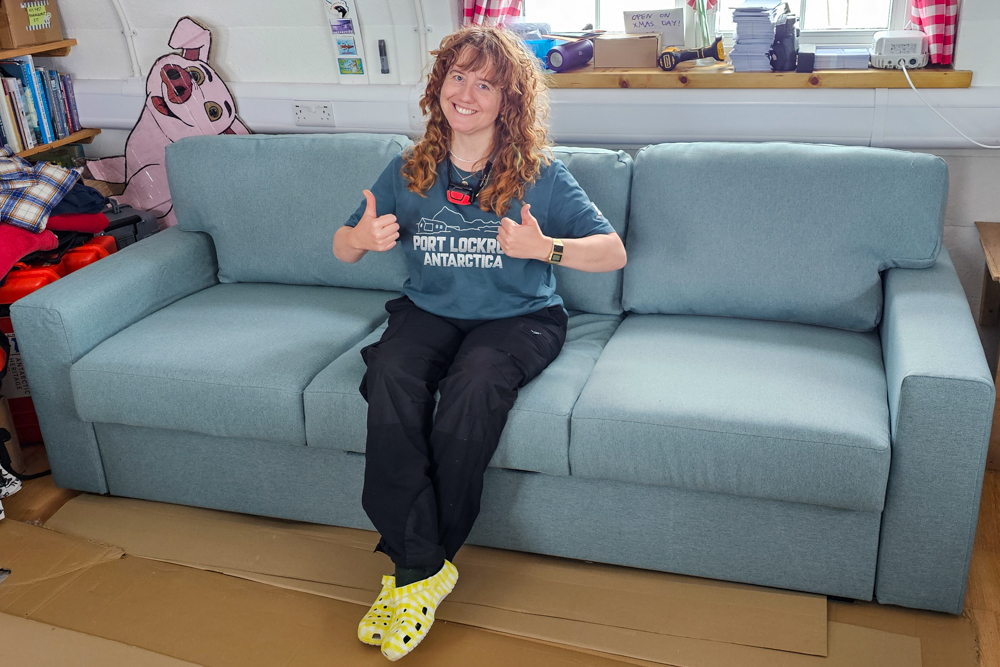
In August, I made my way down to my local Swedish furniture store, fuelled up with a 99p veggie hotdog and got to work. I sat, reclined, lay, lounged and flopped on as many sofas as I could find, considering and reconsidering every possibility. Eventually, I saw it: a vision in glacial teal. Spacious enough to accommodate at least four fifths of a Port Lockroy team, yet flat packable enough to fit on a UK standard pallet.
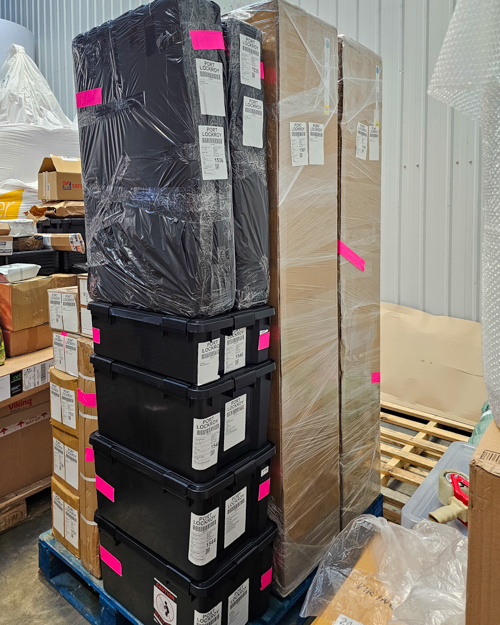
Packed up and ready to begin the journey south (UKAHT)
Next stop was ordering and packing the sofa, ready for transportation South. A route had been found. From Cambridgeshire to the Netherlands to meet with the Oceanwide vessel Plancius, which kindly agreed to carry our sofa on board for their month-long journey to the Antarctic Peninsula. It was a team effort, waterproofing the boxes in the warehouse, carefully labelling each part and recording in our shipping database and ensuring not a single allen key went missing. Eventually, we waved off the sofa in early September.
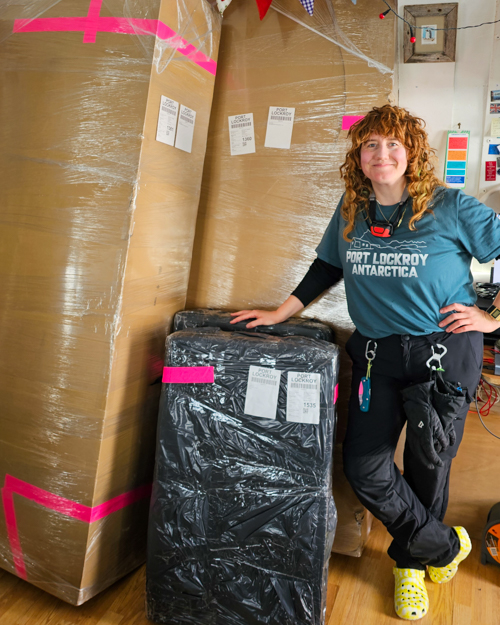
Time to get to work (UKAHT)
A mere two months later, I found myself at the shore on Goudier Island waiting for the wonderful crew of the Plancius to deliver our sofa. They expertly navigated the rocky bay in a zodiac, safely carrying the precious cargo to the shore. From there, it was all hands on deck; the team carried boxes up to our Nissen home. Our gentoo neighbours looked on with curiosity; they were more than happy to sit on nests made of rocks.
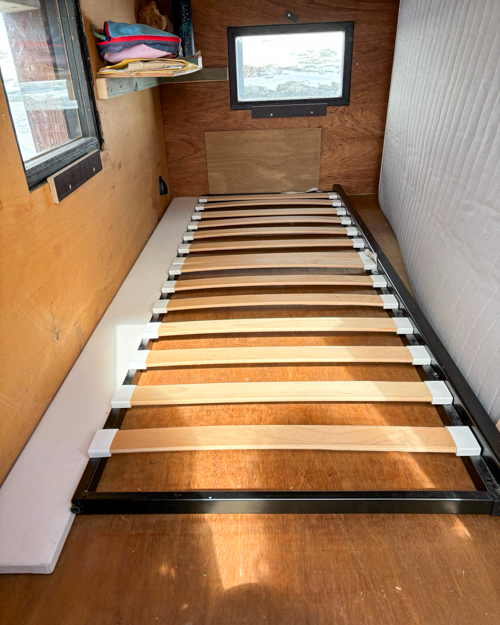
The old frame found a new home (UKAHT)
Before assembly could take place, the old sofa had to be disassembled. It was broken down piece by piece. The fabric was saved to make new cushions; some chipboard was rescued and repurposed to make a lid for a crate, and even the frame of the sofa bed had a new life as a bed frame in our polar pod. Any parts that couldn’t be reused were loaded onto RSS Sir David Attenborough, ready for recycling back in the UK.
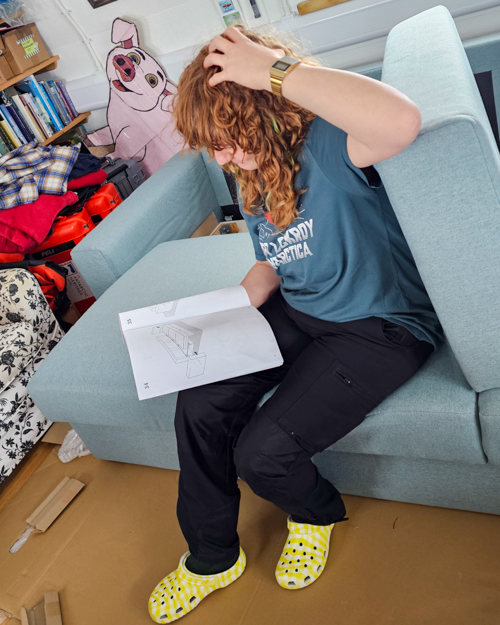
Rachel gets to work (UKAHT)
Finally, all that was left was to assemble the new sofa. Instructions were followed, many cups of tea were drunk, and even a few tears were shed. But with only one minor incident, that I don’t care to elaborate on, the sofa was here! And we were ready to watch The Simpsons, Friends, The Royle Family, or any other sofa-centric sitcom.

Sitting pretty in one of the most remote lounges on Earth (UKAHT)
Read more
Support our work
Protect Antarctica’s heritage
Every membership and donation we receive helps our expert teams deliver vital conservation work across the heritage sites that we preserve. Without your support, sites of great importance in Antarctica’s history could quickly deteriorate, taking with them historic artefacts, tales of scientific advancement and human endeavour that inform how we, as a global community, view and value Antarctica today. With your help, we can continue to conserve this special continent to ensure its protection for years to come.

Follow a unique colony at the end of the world
The gentoos of Port Lockroy are perhaps some of the most famous penguins in the world! The colony made their home with us on Goudier Island over 30 years ago and we have been studying and contributing to their protection ever since. Inquisitive, fluffy and funny, we love sharing their activity with everyone around the world.