






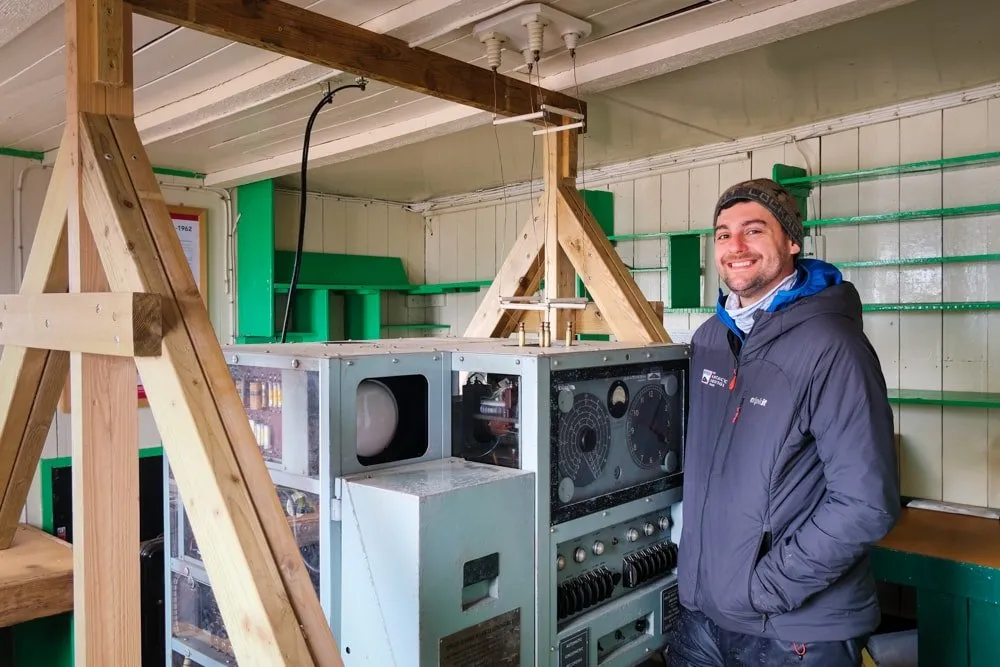
Conservation carpenter Dan Cheetham explains how saving Bransfield House involved dismantling the Beastie: a half-ton ionosonde that had outlived the floor beneath it.
As we peered down, the bearer supporting the floor on the Ionospherics Room side had almost completely severed. What remained was an ugly, splintered jaw of torn timber, propped awkwardly against the coarse granite rubble that had been piled around the concrete shoring boards some seventy years earlier.
The floorboards themselves appeared to be in good condition as I carefully followed my pencil line with the multitool’s blade. This was true of most of the floor aside from the unmistakable dip in the centre of the room, the calling card of “The Beastie”, which had been sitting there only a few days before.
Jo and I still felt compelled to comment aloud as I lifted the final board of the hatch, despite knowing exactly what lay beneath it, and why the hatch had been created in the first place. The torn timber stood out sharply against the grey bedrock.
The ionosonde, affectionately known as The Beastie, is, in my opinion, the undeniable highlight of the Ionospherics Room at Port Lockroy. Standing 1.5 metres high, a metre square, and weighing nearly half a ton, it looms as the goliath of Base A, entirely indifferent to the laws of floor loading.
This was a machine born of the golden age of 1950s scientific ambition: a purposeful marriage of electrical and mechanical systems, laced with high-voltage power and unapologetic complexity. The ionosonde was used to measure the ionosphere, the part of our upper atmosphere electrified by solar radiation. By mapping it, the base team could bounce radio waves off this charged layer, enabling long-range communication in one of the most remote places on Earth.

It looked less like something designed to be moved and more like something designed to stay exactly where it was.
I first began researching the ionosonde in May 2025, after being selected as part of the 2025/26 carpentry (a loose term) team. During my interview, Ruth Mullett, Head of Conservation, casually mentioned that the ionosonde would need to be moved and then, once I’d returned to my chair, politely listened to a monologue about my collection of early- to mid-20th-century electronics, ranging from valve radios to Geiger counters.

When I was asked to undertake the pre-deployment research into how to disassemble a machine that few had ever seen – and even fewer had worked on – I was immediately excited to get stuck in.
After six months of trawling the internet, visits to archives and science museums, and long conversations with the founder of the Virtual Radio Museum (thank you, Allan!), I felt confident that we had done everything humanly possible to prepare ourselves to dismantle The Beastie without damaging the machine, the building or our ourselves.

The morning after I stepped ashore at Port Lockroy, Jo and I went straight into the Ionospherics Room. Jo had arrived a week earlier and had already dismantled the built-in furniture, leaving just two roof supports standing. After gingerly checking them for load-bearing capacity – and discovering they were doing very little, thanks to the absence of snow on the roof – we moved them aside as well, leaving the ionosonde as the sole monolith in the room.
With the Perspex panel coverings removed, we could fully see the complex machine within. It quickly became obvious that, while our research had been thorough, it had only taken us so far. We knew what to expect and had taken the appropriate safety precautions (mercury valves and beryllium diodes being notable incentives for caution), but we didn’t have anything resembling a clear method for how to proceed.

In the end, it came down to a stringent system of labelling and the combined experience of our misspent youths (now stretching well into adulthood) enthusiastically fiddling with electronics and machines, usually without instructions and occasionally with consequences.
It soon became clear that the clever people who built the ionosonde had done so with Antarctica firmly in mind. The machine was filled with trays of components, each neatly divided into individual cassettes, all performing their own functions and connected by an inch-thick wiring loom and multiple plugs. Modular magic. This meant the machine could be upgraded, adapted or repaired simply by unplugging a cassette and slotting in its replacement.

We realised that not only was disassembly achievable, but reassembly in the workshop, in one piece, was also realistic, the safest option. Breaking it down into dozens of boxes had been plan B, but that would have robbed the museum of valuable visitor space.
We started by giving each face a compass bearing and numbering each shelf. Many of the cassettes had their function stamped on the top, which, combined with the already-numbered plugs, allowed us to label and lock each cassette into its rightful spot in three-dimensional space within the ionosonde frame.
Then came the magic moment.
I unscrewed the bolts and removed our first cassette, instantly realising half our work had already been done. As we slid the cassette out – Jo on one side, me on the other – we both spotted a permanent marker scrawl on the shelf. It was a label naming the component from the legendary Alan Carroll restoration in 2001. I’d read about it but never seen many photos. Now it was staring back at us like a ghost.

So we continued, following in Alan’s footsteps using a conservation-friendly labelling system, realising our carefully laid plan wasn’t just ours, it was a re-enactment of conservation history.
At one point, as Jo turned a cassette over, I couldn’t help exclaim with excitement. Underneath wasn’t a neat little circuit board with every function hidden in a silicon chip. It was a riot of components in every colour and size, ranked and filed, with multicoloured wires criss-crossing like a toddler’s first abstract masterpiece. This was extremely cool!
Once most of the cassettes were out, we separated and lifted the two individual frames, cathode ray tube and control face intact, though we did have to wrestle a few chain drives that transferred dial movements from the user interface to the operating cassette. The frames were then moved onto their trolley atop the concrete plinth in the workshop, and reassembly began. Cassette by cassette, in exactly the reverse order of disassembly, taking extreme care for glass valves and mercury-filled components.

With the final screws tightened, the last piece of Perspex in place, and the mercury spill kit still unopened, The Beastie was once again whole.
Now, with guidance from our visiting structural engineer, we can begin relifting the floor and repairing the torn bearers. Future-proofing is the goal, adding extra strength to cope with Port Lockroy’s increasing snowfall.

For Beastie, the plan is to construct a substructure that transfers the ionosonde’s weight directly to the bedrock, easing the strain the building has borne for more than 70 years. We can’t build into the bedrock itself, in line with Antarctic Treaty regulations, but we have a plan that will protect both the building and its remarkable contents.
My only hope is that I make it back for the season when Beastie returns home: any excuse to play – I mean work – with this amazing machine once more.
If you love a place, protect it
UKAHT is committed to making Antarctica, its heritage and its stories accessible to everyone.
Eighty years in Antarctica have left their mark on this beloved site. Now, Port Lockroy urgently needs restoration to protect its future. Please donate today.
Adopt a penguin
follow a unique colony at the end of the world
Your adoption directly supports on-site colony monitoring and conservation at Port Lockroy. Funds go directly to paying for a wildlife monitor to travel to Antarctica and study the penguin colony at Port Lockroy for the austral summer.