







After a season as wildlife monitor at Port Lockroy, Pete Watson shares the most interesting facts about gentoo penguins.
At the UK Antarctic Heritage Trust, we have a particular soft spot for gentoo penguins. With their bright orange beaks, white-feathered bonnets and rosy feet, they are our favourite penguin species – not least because more than 1,000 of them make their home at our flagship base, Port Lockroy on Goudier Island. They can also be found at nearby Damoy, further south at Detaille and across the Antarctic Peninsula.
After spending the 2025–26 season living alongside the Port Lockroy colony as UKAHT’s wildlife monitor, I developed an even greater affection for them. I spent my days counting nests, eggs and chicks, observing their behaviour and becoming intimately acquainted with an extraordinary amount of pink guano. Our monitoring programme, running since 1996, helps us understand the colony and the impact of human visitors upon it.
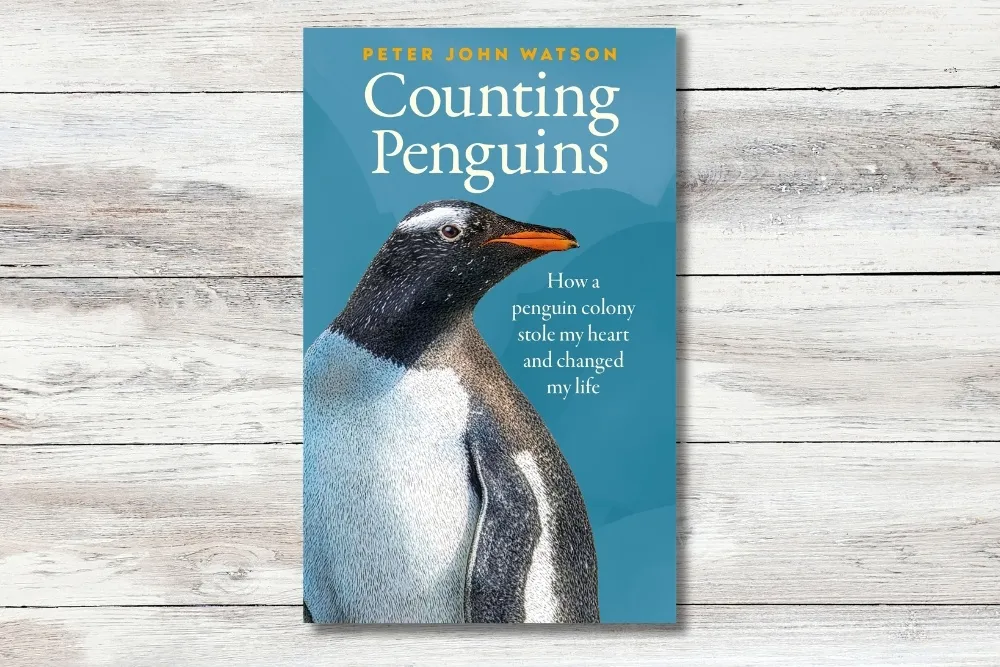
The experience inspired my book, Counting Penguins, about my season at Port Lockroy and what those months at the end of the world taught me about penguins, Antarctica and myself.
From catastrophic moulting and pebble-stealing to high-speed swimming and projectile poo, here are my favourite facts about these endlessly fascinating birds.
Interesting facts about gentoo penguins
1. The colony at Port Lockroy is home to over 1,000 gentoo penguins and has a special place in our hearts. Every year, we send a team to the base to run the world’s southernmost post office and museum there.
2. We’ve been surveying the colony at Port Lockroy since 1996. It has run every year except for 2020/21, when the base was closed due to the pandemic.

3. Gentoo penguins are found on the Antarctic Peninsula, Subantarctic islands, southern continental coasts and islands, and several South Atlantic islands.
4. Gentoo penguins are the third largest penguin, after the emperor and king.
5. Adult gentoo penguins grow to between 70- 90 cm (27- 35 in) tall and weigh between 4.5- 8.5 kg (10- 19 lb).
6. Once a year, gentoo penguins undergo “catastrophic moulting” where they replace their entire plumage of feathers by shedding the old feathers and growing new ones. At one point during this moult, the penguins will have two layers of feathers as the new ones begin to emerge while the old ones remain attached.

7. It’s estimated there are around 774,000 adult gentoo penguins in the wild.
8. As such, gentoo penguins are classified as ‘stable’ and of ‘Least Concern’ (LC) on the IUCN Red List of vulnerable species.
9. The Latin name for Gentoo penguins is Pygoscelis papua which means brush-tailed.
10. Gentoos have the most prominent tail of all penguins – it sticks out behind them and sweep from side to side as they walk.

11. Gentoo penguins are the world’s fastest underwater birds. They can reach speeds up to 36kmph (22mph) per hour.
12. Gentoos can dive to depths of up to 170-200m (560-660ft).
13. During deep dives, gentoo penguins reduce their heart rate from their usual 80-100 beats per minute (bpm) down to 20bpm.
14. Gentoo penguins usually mate with the same partner every year and rear two chicks on nests made of pebbles and feathers.

15. Gentoos build their nests from pebbles and moulted feathers.
16. Gentoos lay two eggs during the austral summer. In southern locations, the first and second-born chicks are equally likely to survive but the second chick to hatch in more northerly islands often dies.
17. After the eggs hatch, both parents forage and feed the young chicks, who remain in the nest for approximately one month. The chicks then form crèches (groups) with other penguins in their colony for protection while their parents are away fishing.

18. Gentoos feed on crustaceans – such as krill – as well as fish and squid. It is krill that can cause a gentoo’s guano (poo) to appear pink.
19. Penguins have a fast metabolism and poop every 20 minutes. Jets of guano can travel as far as 1.2 metres (3.9ft)!

20. Gentoo penguins are closely related to Adélies and chinstraps but have distinctive orange-red bills and feet.
21. Gentoo penguins live for around 15 to 20 years in the wild.
22. Occasionally, gentoo penguins are born with a rare genetic condition called leucism which, due to a lack of pigmentation, causes the penguin to be white. While it does them no harm, it can cause them to be more vulnerable to predators as they can be more easily seen.

If you love a place, protect it
UKAHT is committed to making Antarctica, its heritage and its stories accessible to everyone.
Eighty years in Antarctica have left their mark on this beloved site. Now, Port Lockroy urgently needs restoration to protect its future. Please donate today.
Adopt a penguin
follow a unique colony at the end of the world
Your adoption directly supports on-site colony monitoring and conservation at Port Lockroy. Funds go directly to paying for a wildlife monitor to travel to Antarctica and study the penguin colony at Port Lockroy for the austral summer.