






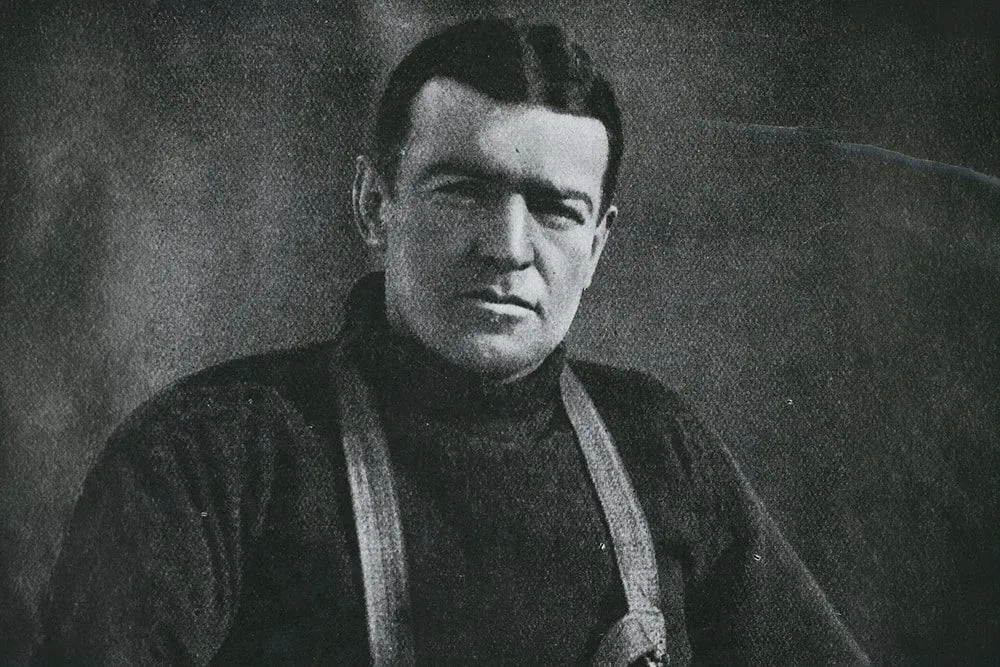
From his Irish childhood and first experiences in Antarctica to the extraordinary survival story of the Endurance, these are the most interesting facts about Ernest Shackleton.
Few names are as closely associated with Antarctica as Sir Ernest Shackleton. Although he never reached the South Pole or completed his planned crossing of the continent, his courage, determination and leadership during moments of extreme danger secured his place in polar history.
Here are some of the most interesting facts about Ernest Shackleton, including a few details that may surprise you.
1. Ernest Shackleton was born in Ireland
Ernest Henry Shackleton was born on 15 February 1874 in Kilkea, County Kildare, Ireland. He was the second of ten children. His family moved to London when he was ten, and Shackleton attended Dulwich College. Although he later became famous for planning and leading ambitious expeditions, he reportedly found conventional classroom education uninspiring. The Royal Geographical Society holds an extensive collection connected to Shackleton and his Antarctic expeditions.

2. He went to sea at the age of 16
Rather than continuing his formal education, Shackleton joined the merchant navy at 16. He spent the following years travelling widely and learning the practical skills required to sail and navigate ships.
In 1898, at the age of 24, he qualified as a master mariner. This meant he could command a British ship anywhere in the world, valuable experience for the polar expeditions that would define his later life.
3. His first Antarctic expedition was led by Robert Falcon Scott
Shackleton first travelled to Antarctica as third officer aboard Discovery during the British National Antarctic Expedition of 1901–04, led by Captain Robert Falcon Scott. In December 1902, Shackleton, Scott and Edward Wilson reached 82°17′ south, setting a new record for the furthest journey south at that time. The expedition was physically punishing, however, and Shackleton was sent home early after suffering from poor health. Far from ending his polar ambitions, the experience strengthened his determination to return to Antarctica as the leader of his own expedition.
4. Shackleton edited Antarctica’s first newspaper
Life aboard a ship frozen into Antarctic ice involved long periods of darkness and isolation. To entertain the members of the Discovery expedition, Shackleton edited the South Polar Times. The expedition newspaper contained articles, poems, illustrations, scientific observations and humorous accounts of life in Antarctica. Copies were typed and illustrated by hand before being circulated among the crew. The project showed a side of Shackleton that would become central to his leadership style. He understood the importance of morale, entertainment and shared purpose during long periods of confinement.
5. He came within around 100 geographical miles of the South Pole
Shackleton returned to Antarctica as leader of the Nimrod expedition of 1907–09. Its principal ambition was to become the first expedition to reach the geographic South Pole. On 9 January 1909, Shackleton and his companions reached 88°23′ south, approximately 97 geographical miles, or 180 kilometres, from the Pole. With supplies running dangerously low, Shackleton made the difficult decision to turn back. The choice may have cost him the South Pole, but it probably saved the lives of his party. On his return to Britain, Shackleton was celebrated as a hero and knighted by King Edward VII. You can read more about Shackleton’s expeditions at Royal Museums Greenwich.
6. He told his wife she would prefer “a live ass than a dead lion”
After deciding to turn back just 97 geographical miles from the South Pole during the Nimrod expedition, Shackleton wrote to his wife, Emily:
“I thought, dear, that you would rather have a live ass than a dead lion.”
The remark neatly captures the thinking behind one of the most important decisions of his career. Shackleton believed his party might reach the Pole, but knew their dwindling supplies would make the return journey dangerously uncertain. Rather than risk dying for the achievement, he chose to bring his men home alive – a decision that helped establish his lasting reputation as a leader who placed human life above personal glory.

7. He took the famous photograph of his own greatest southern journey
A photograph taken at the southernmost point reached by the Nimrod party shows Jameson Adams, Eric Marshall and Frank Wild standing beside the Union Jack. Shackleton himself is missing from the photograph for a simple reason: he was behind the camera taking it. Despite not appearing in the image, the achievement made Shackleton one of the most famous explorers of his generation. At the time, no human had travelled further south.

8. His expedition made several Antarctic firsts
Although Shackleton did not reach the South Pole during the Nimrod expedition, members of his team made several important achievements. A party led by Edgeworth David became the first to reach the approximate location of the South Magnetic Pole. Another group completed the first ascent of Mount Erebus, the active volcano on Ross Island. Shackleton’s southern party also discovered a route through the Transantarctic Mountains via the Beardmore Glacier, allowing them to reach the high Antarctic Plateau.
9. Endurance was named after his family motto
Shackleton originally purchased the ship that would become Endurance under the name Polaris. He renamed it in honour of his family motto, Fortitudine vincimus, usually translated as “By endurance we conquer”. The name proved remarkably appropriate. In 1914, Shackleton departed on the Imperial Trans-Antarctic Expedition, intending to complete the first crossing of Antarctica. Instead, Endurance became trapped in the pack ice of the Weddell Sea before the expedition could reach its intended landing point.
10. The famous Shackleton recruitment advert may never have existed
One of the best-known stories about Shackleton claims that he advertised for expedition members with a brutally honest notice warning of low wages, bitter cold, darkness, danger and a doubtful return. Despite its fame, researchers have never located an original copy of the advertisement in a newspaper or archive. It is now widely regarded as apocryphal, although Shackleton certainly received thousands of applications from people hoping to join his expedition.
The ship remained trapped for months before the pressure of the moving ice crushed its wooden hull. It finally sank in November 1915. The supposed advert may capture the risks of Antarctic exploration, but it should not automatically be treated as Shackleton’s authentic words.
11. The crew of Endurance never reached the Antarctic mainland
Shackleton’s plan was to land in the Weddell Sea and cross Antarctica on foot, passing through the South Pole before reaching the Ross Sea. However, Endurance became trapped before the party could land. Shackleton’s grand geographical mission was replaced by a far more urgent objective: keeping his men alive.

The 28 men lived aboard the trapped ship and later camped on the drifting sea ice. When the ice began to break apart, they launched three small boats and eventually reached the remote and uninhabited Elephant Island.
12. Six men sailed around 800 miles in a lifeboat
With no realistic prospect of rescue on Elephant Island, Shackleton and five companions set out in the James Caird, a lifeboat measuring just over six metres long. They sailed around 800 miles across the Southern Ocean towards South Georgia, enduring freezing conditions, towering waves and hurricane-force winds. Much of their survival depended on the remarkable navigational skill of Endurance captain Frank Worsley. After 15 days at sea, they reached the uninhabited southern coast of South Georgia.
13. Shackleton crossed South Georgia without a map
Landing on South Georgia did not immediately bring the men to safety. The island’s whaling stations were on the opposite coast, separated from them by an unmapped interior of mountains and glaciers. Shackleton, Worsley and Tom Crean set out on foot with basic equipment and almost no sleep. After travelling continuously for approximately 36 hours, they reached the whaling station at Stromness on 20 May 1916.
Help could finally be organised for the men left behind. Several rescue attempts were defeated by sea ice, but Shackleton eventually returned to Elephant Island on 30 August 1916. The South Georgia Heritage Trust shares more about the journey, Shackleton’s arrival at Stromness and the heritage sites associated with the expedition.
14. Every member of the Endurance party survived
Perhaps the most remarkable fact about the Endurance story is that every person aboard the ship survived. The men had spent more than a year and a half isolated in one of the world’s most hostile environments. Their survival involved difficult decisions, careful rationing, extraordinary seamanship and several dangerous journeys through ice and open water. Shackleton’s ability to maintain morale and adapt his plans as conditions changed is why his leadership continues to be studied today.
15. Shackleton died during his fourth journey to Antarctica
In 1921, Shackleton set out once again for the south aboard Quest. His precise plans changed several times, but the expedition intended to explore parts of the Antarctic and sub-Antarctic regions. In the early hours of 5 January 1922, while Quest was anchored at Grytviken in South Georgia, Shackleton died following a heart attack. He was only 47. At the request of his wife, Emily, he was buried in the cemetery at Grytviken rather than being returned to Britain. His grave continues to be visited by people travelling to South Georgia.

16. The wreck of Endurance was found more than a century later
For more than 100 years, Endurance remained hidden beneath the Weddell Sea. On 5 March 2022, the wreck was located at a depth of 3,008m (9,869ft). It was found approximately four miles south of the position recorded by Frank Worsley when the ship sank in 1915, demonstrating the extraordinary accuracy of his navigation. The ship was remarkably well preserved in the cold Antarctic water, with its name still clearly visible across the stern. Today, the wreck is cared for by the UK Antarctic Heritage Trust. Learn more about our conservation management plan for the wreck.

Remembering Ernest Shackleton
These interesting facts about Ernest Shackleton reveal a story that is about much more than reaching a particular point on a map. Shackleton experienced disappointment, failure and disaster, but he repeatedly adapted when circumstances changed. His greatest expedition did not achieve its original objective, yet it became one of history’s most extraordinary stories of survival.
More than a century after his death, Shackleton remains an enduring figure in Antarctic history and a powerful example of leadership, resilience and responsibility in the face of overwhelming odds.
Lead image: Sir Ernest Shackleton, c1907/CC BY-SA 3.0
If you love a place, protect it
UKAHT is committed to making Antarctica, its heritage and its stories accessible to everyone.
Eighty years in Antarctica have left their mark on this beloved site. Now, Port Lockroy urgently needs restoration to protect its future. Please donate today.
Adopt a penguin
follow a unique colony at the end of the world
Your adoption directly supports on-site colony monitoring and conservation at Port Lockroy. Funds go directly to paying for a wildlife monitor to travel to Antarctica and study the penguin colony at Port Lockroy for the austral summer.