






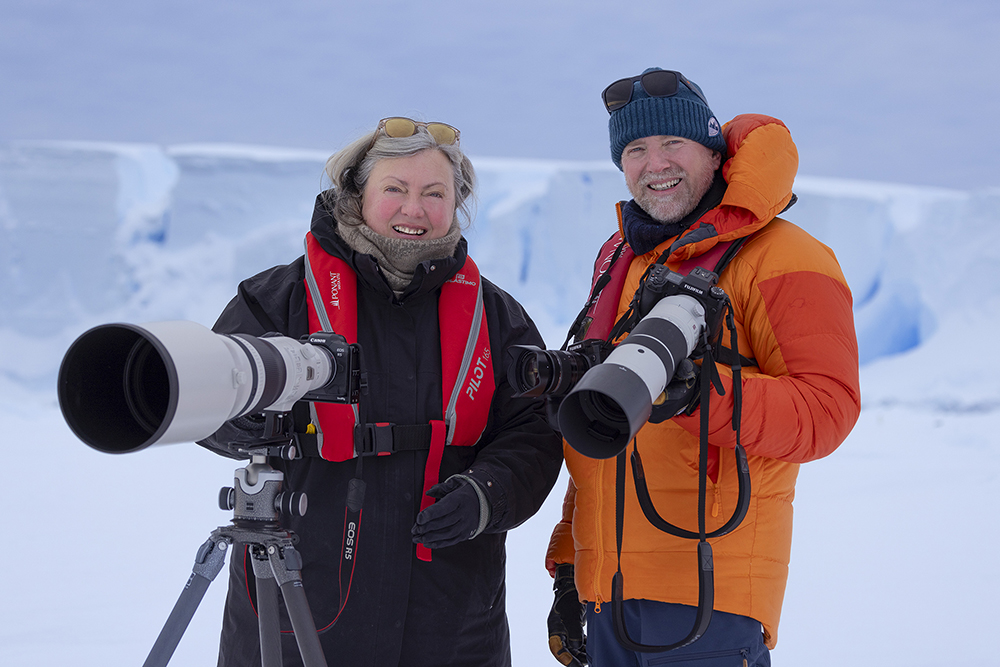
Polar photographers Sue Flood and Ian Dawson discuss their new collaborative book Midnight Sun, the extraordinary light and wildlife of the polar regions, and why photography can play a powerful role in inspiring people to protect these rapidly changing places.
For decades, photographers Sue Flood and Ian Dawson have travelled to some of the most remote corners of the Arctic and Antarctic, capturing everything from emperor penguin colonies and hunting polar bears to the vast, fragile landscapes of the frozen world. Now, they have brought their work together in Midnight Sun, a new book celebrating the remarkable light, wildlife and landscapes found at the ends of the Earth.
Both longstanding supporters of UKAHT, Sue and Ian share our belief in the power of storytelling to connect people with Antarctica. We caught up with them to talk about working together in extreme environments, the images that have stayed with them, the growing urgency of documenting a changing climate – and, of course, their favourite penguins.
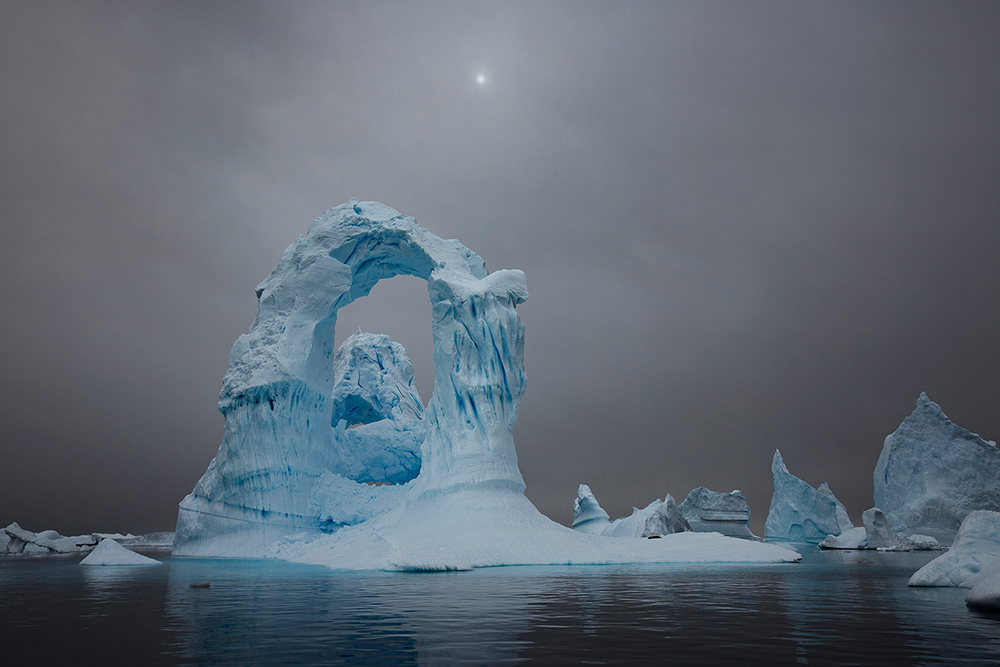
Midnight Sun is such an evocative title. What does it mean to each of you, and how does it capture the spirit of the book?
There’s a point each spring, both north and south, where the sun rises, never setting for several months, the evocatively named midnight sun, where it spins around the horizon above your head. It seemed an obvious choice for a title.
Morning, evening, night, all of it dissolves into one long, unbroken day. For a photographer, that constant light is a gift. Polar light is unlike anywhere else on earth, washed in vivid blues, golds, and subtle shades of grey. Its return stirs something in the place itself, affecting the rhythms of the animals and people who call it home – a rhythm reflected in our first collaborative book of the polar regions.
There’s a contradiction inside the title, and its spirit runs through the book. Each of these images was taken at a given place and a given moment but photographed under this almost permanent light. Two contradictory timelines set side by side: the unchanging sun set against a landscape that is now visibly changing at a pace we’re only beginning to reckon with.
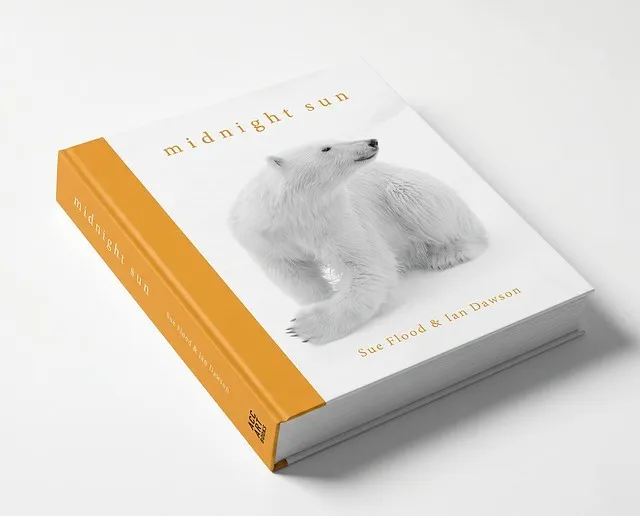
You have both spent years photographing the polar regions. What made this the right moment to bring these images together in a book?
The timing just felt right. We started working together just over five years ago, and in that time we’ve been lucky enough to witness and record some truly remarkable places. These places don’t sit still and wait for you, so we feel the need to document them while we still can.
Photography can be a pretty solitary pursuit, but in these environments, working as a team makes a real difference. You’re dealing with extreme conditions, narrow windows of optimal light, logistics that can go wrong in an instant. Having someone else there, someone you trust, changes what’s possible. We have very distinct styles, but they complement each other in a way that’s made the work stronger than either of us could have managed alone.
After five years of that partnership, and after gathering so many images it made sense to bring them together in a single project, something that told a fuller story – not just of the places themselves, but of what it’s been like to witness them changing year after year.
How did the collaboration work in practice? Did you find that you looked for different things through the lens, or were you often drawn to the same moments?
In practice, it worked because we really do see the world differently, and that’s exactly what made it complementary rather than competitive. That’s the beauty of photography, you can stand ten photographers in front of the same scene and get ten completely different images back. None of them wrong, just witnessed with different eyes.
Sue and I are a good example of that. One of us will see something in a creature, a landscape, or a person that the other will pass by, and I’m sure the same is true in reverse. We’re not looking for the same thing, and that’s the point. Every so often, of course, something in front of us is so remarkable, so unusual, that we’re both drawn to it at the same moment, you can’t help it. But even then, what we each come away with tends to be different. Not one better than the other, just genuinely different.
Polar photography can be full of spectacle – ice, wildlife, weather and light. How do you go beyond the obvious beauty to tell a deeper story?
We guess, for us, that’s really a deeper conversation about the nature of photography itself – and there isn’t just one answer to it.
Sometimes an image simply presents itself, and your only job is to be ready when it does so. When that happens, it feels like a gift. But what we really enjoy, what keeps us coming back, is looking deeper than that. Trying to get beyond the surface of a thing.
With a subject, that often means waiting for the quieter moments. Those moment when they or it have grown accustomed to you, stopped paying attention, and is behaving naturally, rather than being effected by our presence. Something essential slips through in that frame that wasn’t there a second before.
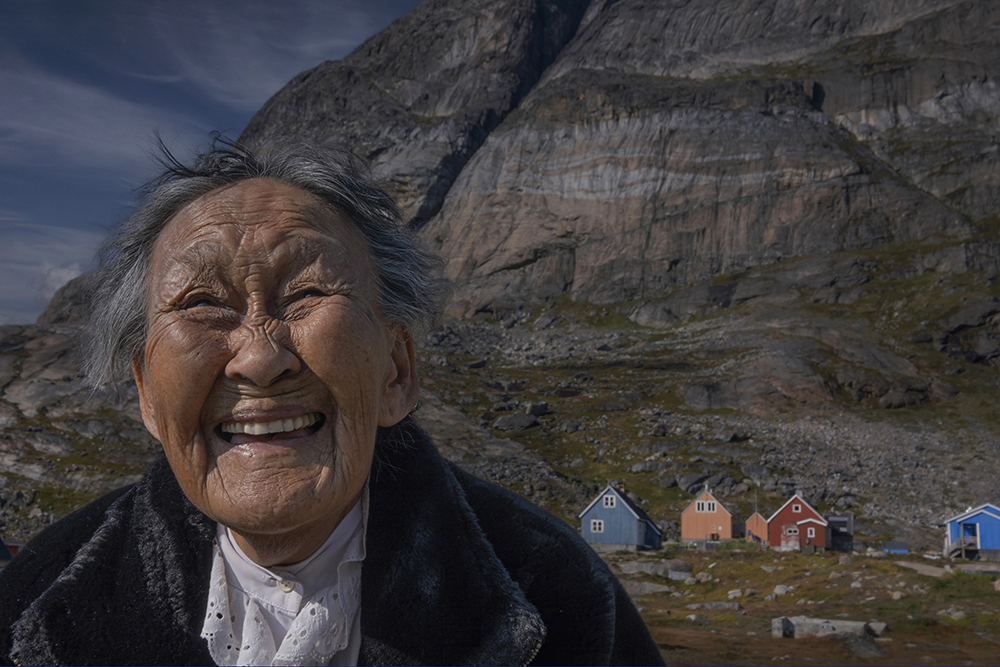
It’s hard to pin down exactly what we’re chasing in these moments. If we had to put it simply, we’d say you’re looking for 1+1 =3, which is a pretty simple way of describing something genuinely difficult to explain. That’s probably why not everyone is a photographer, in the end. There are techniques, of course – different lenses, spending more time to build trust with a subject. But there’s no hard and fast formula for it. If there were, it would be easy.
Was there a particular image, journey or encounter that became central to the book for each of you?
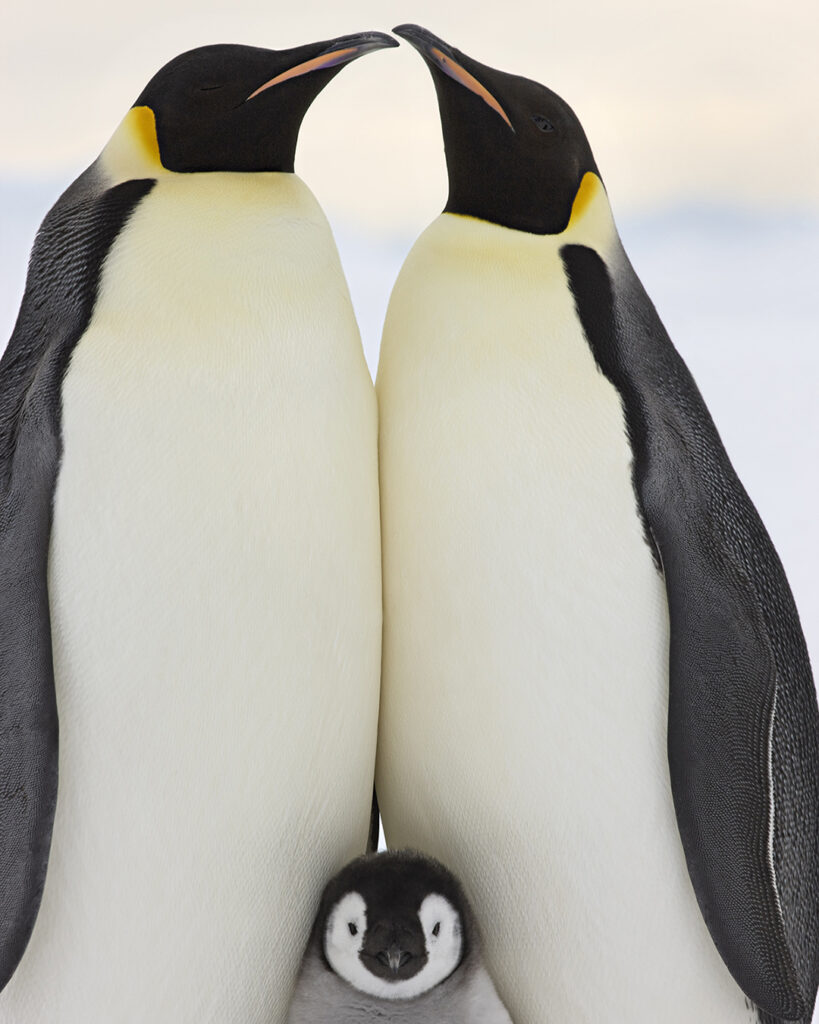
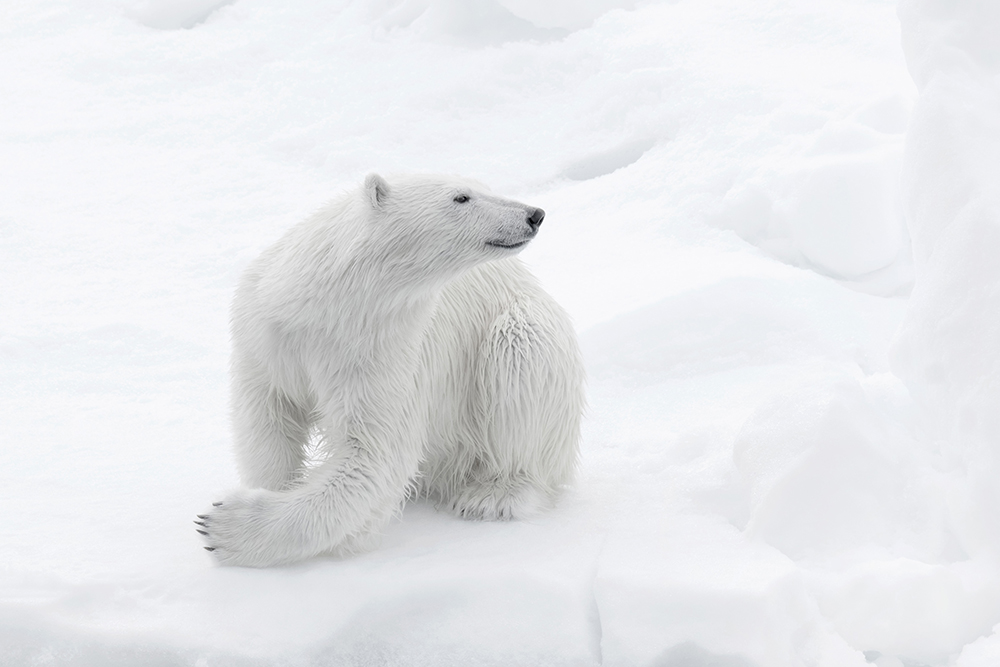
SF: I’ve been fortunate to spend significant amounts of time over the last few decades photographing the iconic species of the Arctic and Antarctic – the polar bear and the emperor penguin. One of my favourite images in the book is my shot of a polar bear with the seal it has just caught, leaving a trail of blood as it drags its prey across the ice. For me, this shot has a graphic simplicity which captures the power of this incredible predator. I’m also incredibly fond of one of the first images I ever took of an emperor penguin – a family in the Weddell Sea. I had the idea of this image in my head before I first went to the colony and hoped I’d find the shot I was looking for. I saw one of the adults approach its mate and their chick, and then they stood together for just a few brief seconds. These stunning birds survive in incredibly hostile conditions to raise their single chick and it was, for me, the perfect moment. I’ve been looking for this shot again over the years but never seen such a lovely composition!
ID: I suppose you’re going to ask me next which is my favourite child. Honestly, the answer would depend entirely on which day you caught me and what mood I was in. But right now, an image of Thwaites Glacier, the so-called “Doomsday Glacier,” holds real significance for me.
It’s a phenomenally difficult place to reach. Tide, ice, weather, every factor plays against you out there. But beyond the sheer challenge of getting to it, Thwaites matters because it’s one of the key indicators we have of how fast our climate is changing. The ice shelf is breaking up rapidly, undercut from below by warming seawater, and that’s expected to accelerate the glacier’s slide into the sea – which carries serious implications for global sea level rise. It’s not an abstract concern out there; you can feel the urgency of it in the landscape itself.
And then, almost in spite of all that, there was this moment, the light, the wind, the spindrift lifting off the ice, that came together for just a few seconds in front of the glacier’s leading face. That’s the image that resulted. It’s since been selected for the 2026 Earth Photo touring exhibition, which feels fitting somehow: a photograph born out of one of the harshest, most consequential places on Earth, standing on its own as a piece of work.
The polar regions are changing rapidly. How do you balance wonder and urgency when photographing places that feel both timeless and fragile?
Wonder and urgency can absolutely exist alongside each other, in fact, we think you need both. There’s the wonder of seeing something no one has seen quite this way before, and right alongside it, the urgency of knowing it may not exist in the same way if you come back tomorrow. Not in some hypothetical, distant-future sense, but in real time. It’s the same with light out there: sometimes you have mere seconds where conditions come together to create an image that may never happen again. That knife-edge is part of the essential excitement of photography.
We think our responsibility as photographers is to show people things they may never get the chance to see for themselves, and we don’t take that privilege lightly. But showing isn’t enough on its own – you have to help people feel something, because people only protect what they’ve come to care about. At this point in our careers, using photography as a means to drive real change has become essential to why we do this work at all. Going forward, that’s exactly where we’re headed, supporting international conservation projects at a genuinely global scale, so this work does more than document what’s disappearing. It has to help protect it.
What does the light of the polar regions teach you as photographers, especially the strange, lingering light suggested by Midnight Sun?
ID: As photographers at home in the UK, night and day give you a natural rhythm – a built-in permission to stop. But working in the polar regions, with 24-hour daylight through the summer, that rhythm disappears entirely. It does something to you psychologically, this nagging sense that the moment you close your eyes to the daylight might be the exact moment you miss the shot. But eventually you have to sleep. You have to draw the curtains, cover your eyes, force some kind of rest, and it plays havoc with your circadian rhythm.
But beyond the toll on our sleep patterns, that light teaches you something important: it teaches you to slow down and really pay attention. We make a distinction between looking and seeing, because they’re not the same act at all. Looking is watching what is in front of you e.g. to get from one point to another; it’s passive and reactive. Seeing is proactive. It’s paying attention. And that, really, is the whole business of being a photographer. It’s watching the light shift, reading the weather as it builds, and having the patience to speculate ‘what might happen if we just wait a little longer?’ Under the midnight sun, you have the luxury and the burden of time to do exactly that. There’s no sunset forcing your hand, no deadline written into the sky. So you learn to wait, to watch, and to trust that if you keep seeing, rather than just looking, the moment to press the shutter will eventually arrive.
SF: The polar regions are my favourite place to photograph. I swear that I have seen more hours of daylight than anyone I know, having spent decades working in the Arctic and Antarctic summers, when the sun never sets. But it’s the quality of light that can be so special. I’ll never forget the incredible light at around two in the morning in the Ross Sea, as the huge tabular bergs were lit by a soft rosy glow – an ethereal and truly awesome sight.
UKAHT works to connect people with Antarctica’s heritage, wildlife and stories. What role do you think photography plays in helping people care about places they may never visit?
That’s the obvious starting point, really. So many of the places UKAHT works to preserve are simply unreachable for most people. That’s where photography and film earn their place. At their best, they don’t just show people what these places look like, they convey how they feel. They become a stand-in for the real thing, something that can be shared and felt across societies all over the world, by people who will never make that journey themselves. This hopefully gives support to the preservation work being carried out at Port Lockroy, Damoy, Stonington etc.
You have both generously supported UKAHT’s fundraising efforts in the past. What is it about our work, and places like Port Lockroy, that resonates with you?
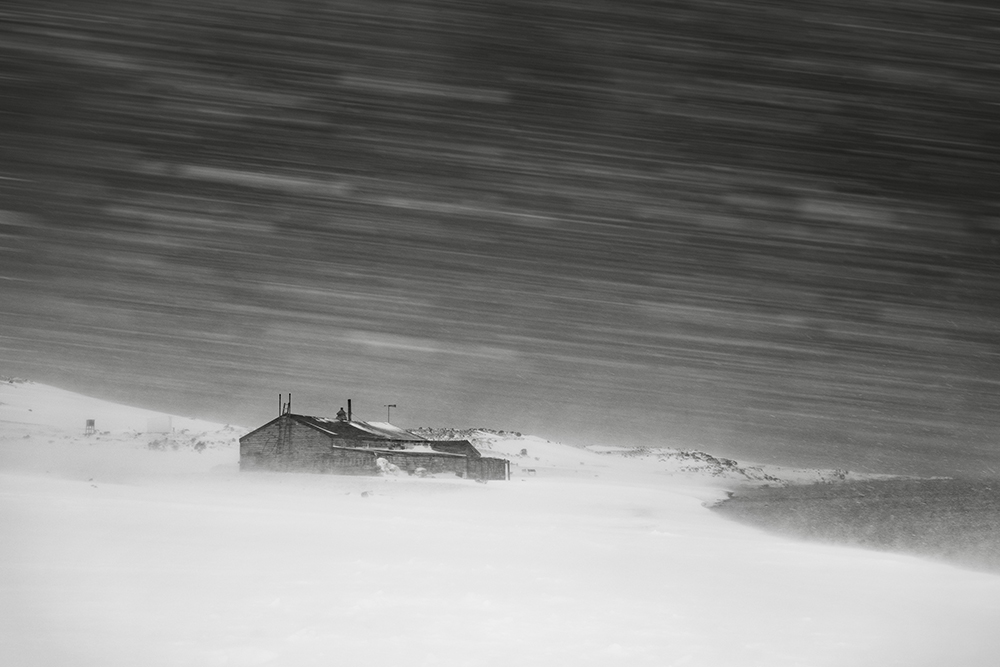
The work of UKAHT is becoming more and more important precisely because of what’s happening to the climate down there. Historically, Antarctica was so consistently cold and dry that, aside from the sheer force of wind, snow and ice, these buildings could simply last for decades untouched. They’re not just empty structures, they’re not bare wooden huts devoid of character. They’re full of the traces of the people who lived there, filled with the everyday effects and belongings of the golden age of exploration. Full of data that have resulted in leaps forward in our understanding of this continent. That’s what makes them so remarkable: you’re not looking at a museum reconstruction, you’re looking at the real, preserved texture of daily life exactly as it was left.
But that consistency is no longer something we can rely on. We’ve experienced rain in Antarctica ourselves, on more than one occasion now, something that would have been almost unthinkable not so long ago. And that shift is increasingly affecting the preservation of these buildings. Moisture does damage that decades of cold and dry never could. So the work UKAHT does isn’t just historically important – it’s become genuinely urgent.
Beyond the preservation itself, we think what resonates with us just as much is the scientific work your staff carry out from these remote outposts. It’s not only about safeguarding the past, it’s about using these places to keep learning, in real time, about a continent that’s moving faster than our sense of it can keep up. That combination, protecting history while actively contributing to the science of the present, is exactly why this work matters so much to us.
What do you hope readers will feel – or perhaps do – after spending time with Midnight Sun?
That’s really for the reader to discover for themselves – what they feel when they sit with these images is theirs to find, not ours to dictate. But if we’re honest about what we hope for, above everything else, it’s that they feel something. A genuine connection to these places, not just an appreciation of a nice photograph.
And from that connection, we hope comes curiosity – a drive to look past the image itself and ask questions about what’s actually happening in these regions, and, in whatever way is available to them, to act on it. That might mean supporting organisations doing real, effective work on the ground – like the UKAHT, or others fighting for these regions in ways we never could in isolation.
If someone closes this book having simply admired the ice, fauna and the light, we’ll have done half our job. But if they close it and feel compelled to help protect what they’ve just seen, even in a small way, then it will have done exactly what we hoped it would.
What’s next for you?
Alongside the book, there’ll be a month-long exhibition at the Royal Geographical Society Pavilion, which we’re really looking forward to. Beyond that, the year keeps moving, and we’ll be heading out to China, Vietnam, and then back deep into Antarctica to focus specifically on emperor penguin colonies, which is work we’ve wanted to spend more concentrated time on for a while now.
And beyond all of that, we are just about to begin working with an international conservation organisation on something we can’t say too much about just yet, but it’s exactly the kind of large-scale, meaningful work we mentioned earlier, using photography to genuinely support conservation on an international level. More on that when we’re able to share it properly.
What luxury item would you each take if you were working at Port Lockroy for the season?
ID: I’m assuming my cameras are already a given rather than a luxury item, so I’ll have to think a bit harder than that. Honestly, after years spent on mountaineering expeditions, I’ve made peace with a fair amount of discomfort – there’s something I actually like about the simplicity of it. Food, shelter, water – that’s really all you need out there, and everything beyond that is a bonus rather than a necessity.
But if I’m forced to pick one indulgence, mango sorbet. So if someone could find a way to keep a steady supply going through a season at Port Lockroy, that would be my luxury of choice. Fresh food becomes of short supply on extended expedition and I do start to crave the things it’s impossible to have. My personal record for a shop bought ice cream is 78 degrees north.
SF: Like Ian, I’m happy with a fair amount of discomfort. I once spent six weeks sharing a tent in the Arctic with three men, with no shower and no loo, so I’m used to roughing it! That said, it was one of the most fabulous trips I’ve ever had, so I can certainly manage with the basics. But I’d not say no to a luxury item… if my grand piano isn’t an option (!) I’d like to take a set of watercolours.
Finally, what’s your favourite species of penguin?
ID: My favourite species of penguin has to be the Adélie penguin, every single time. Single-minded, boisterous, with a character that completely belies their size. I know Sue will say emperor penguins, given her own soft spot for them, but for me it’s always been the Adélies.
They’re such characters, in fact, that Dr George Murray’s scientific study of 1915 on their behaviour was considered too ‘depraved’ to publish, and ended up being suppressed in the depths of the Natural History Museum for almost 100 years, rather than released to the public. That tells you everything you need to know about their bold, unpredictable, and “hooligan” like behaviour (Dr G Murray) – I find something wonderful in that.
SF: Ian’s right. Of course, I’ll say it’s the emperor! My last book was called Emperor: The Perfect Penguin, so not a surprise. This gorgeous bird, the largest of all the penguins, is exquisitely beautiful. But the amount of effort required by the parents to raise their single chick in one of the most hostile environments on the planet, breeding during the Antarctic winter, is nothing short of incredible. So they get my vote, although the Adelie is a close second!
Discover more of Sue and Ian’s polar photography at sueflood.com, norddigital.co.uk and midnightsunvoyages.com, or follow their latest adventures on Instagram at @suefloodphotography, @iandawsonnord and @midnightsunvoyages.
Lead image: Sue Flood and Ian Dawson on location in Antarctica (Rick Guest)
Join Ian and Sue at the launch of Midnight Sun at the Royal Geographical Society in London on Tuesday 6 October 2026. Hosted by Sir Michael Palin and introduced by UKAHT’s Camilla Nichol, the evening will explore the stories behind their extraordinary Arctic and Antarctic photography, followed by audience questions.
UKAHT supporters can also attend a pre-event drinks reception and receive 20% off tickets using the code UKAHT at checkout. Priority booking closes 22 September.
Can’t make the event? Midnight Sun is available to buy from the UKAHT online shop ahead of its general release in spring 2027, with proceeds supporting our work.